What coaching platforms cost
Five vendors. Five pricing shapes. A dated list price is the start of the calculation, not the answer.
“How much does coaching software cost?” has no honest single answer. A plan may charge by active client, by portal, by features, by contacts or as a flat subscription. A $20 entry plan for two clients and a $57 plan with unlimited clients do not compete at the same practice size.
The table below transcribes published US-dollar list prices from five vendors on 23 September 2026. It is a market sample, not a survey of what coaches actually paid. Taxes, payment processing, discounts, team quotes and specialist tools are outside the table unless named explicitly.
Coachful publishes Coaching Stats and sells one of the platforms in this market. Its customers retain the price first assigned to them, so this static cross-domain guide does not substitute a generic Coachful amount for a reader’s actual plan. The public Coachful plan page describes the current offer; existing customers should use the price in their own account.
The short answer
The five verified platforms here enter at $20 to $179 per month, but those entry plans buy different capacities. At 20 active clients, CoachAccountable lists $120, Delenta Pro lists $49 for up to 40 portals, Paperbell remains $57, and Kajabi Basic remains $179 subject to its product and contact limits. Compare the plan that fits your workflow, not the lowest number on a pricing page.
- CoachAccountableStarterEntry monthly$20/moAnnual billNot listedMain limit or gate2 active clients; $40 for 5, $70 for 10, $120 for 20, $250 for 50
- DelentaStarterEntry monthly$29/moAnnual bill$229Main limit or gate10 client portals; Pro $49 for 40, Premium $79 for unlimited; Teams requires a quote
- CoachVantageClarityEntry monthly$39/moAnnual bill$420Main limit or gateUnlimited coaching engagements; 4 e-signature requests per month and 2 booking pages
- PaperbellOne planEntry monthly$57/moAnnual bill$570Main limit or gateUnlimited clients, sessions and packages; one flat feature set
- KajabiBasicEntry monthly$179/moAnnual bill$1,716Main limit or gate5 products and 2,500 contacts; Growth $249, Pro $499 month-to-month
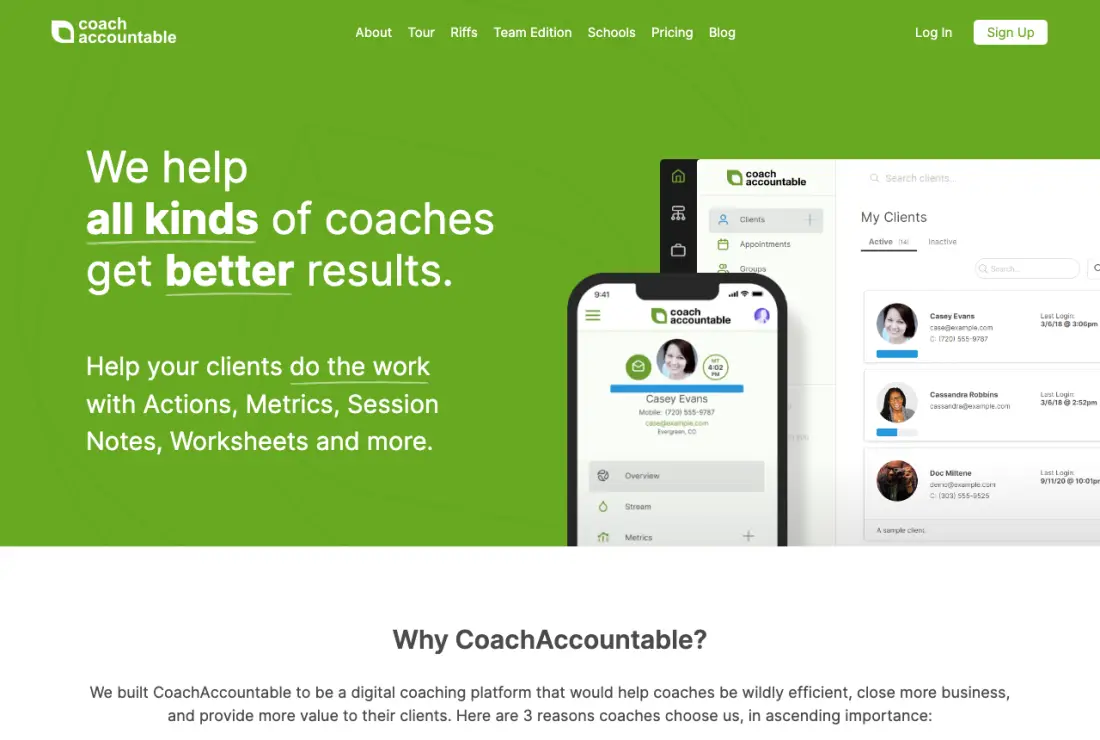
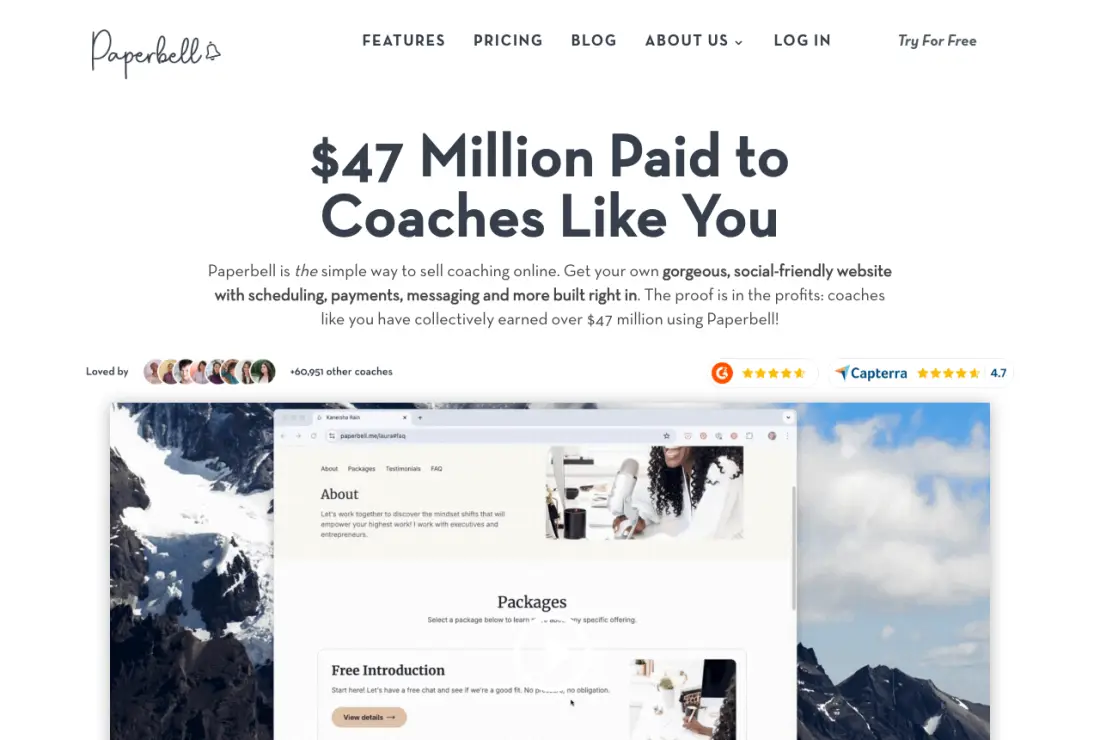
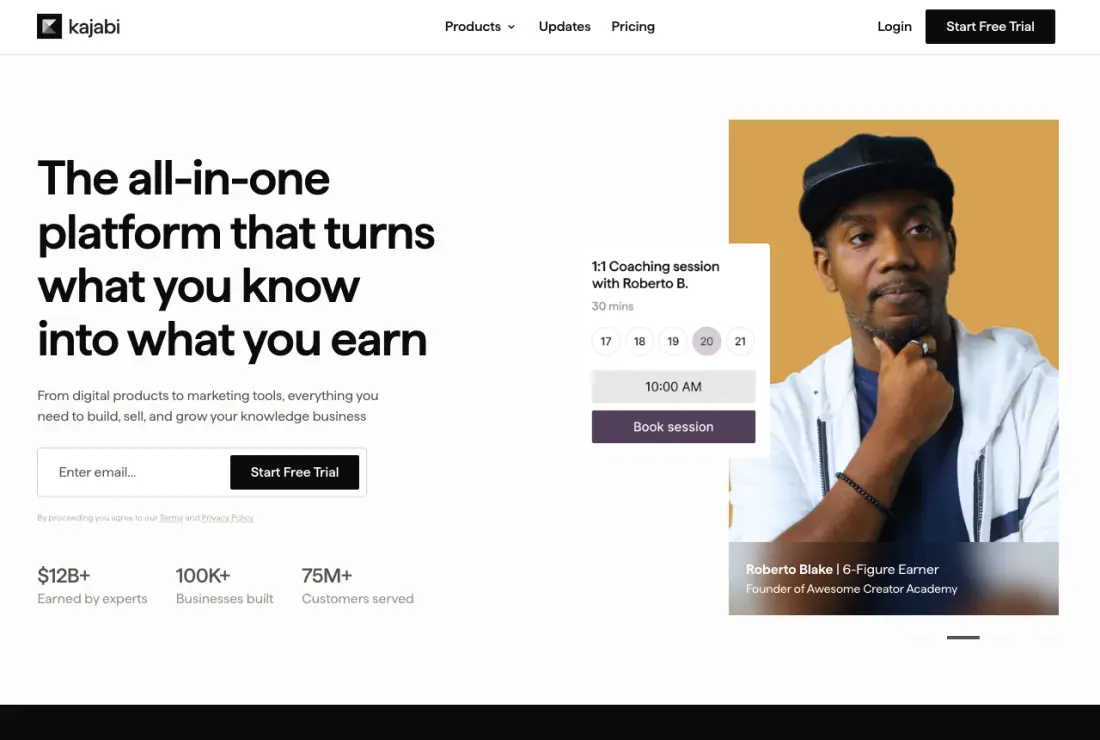
Five vendors, five public sites
These captures show each vendor’s public home page, not a logged-in product screen or proof of today’s price. Follow the primary pricing links above for the current bill.


Why entry prices mislead
CoachAccountable bills by active clients. Its $20 Starter level covers two. The same vendor lists $70 for ten, $120 for twenty and $250 for fifty. The software does not become a different product at those levels; the denominator changes.
That is a rational model if your client count moves with revenue, but the first invoice is a poor forecast for a full practice.
Delenta gates both capacity and capabilities. Starter is $29 monthly with ten prospect and client portals. Pro is $49 with forty and group coaching. Premium is $79 with unlimited portals, courses and mobile app access.
A coach who needs a course at eight clients is buying Premium for the feature, not the count.
CoachVantage is a flat subscription with usage limits. Clarity is $39 monthly, but lists four e-signature requests each month and two booking pages. Aha! is $59 and expands those limits. Paperbell is flat at $57 monthly, with unlimited clients, sessions and packages according to its pricing page.
Its scope is different from a platform built around daily habit tracking, so equal invoices do not mean equal work covered.
Kajabi bills for a content business. Basic is $179 month-to-month with five products and 2,500 contacts; Growth is $249 with 50 products and 25,000 contacts; Pro is $499 with unlimited products and 100,000 contacts. A coach buying Kajabi for one-to-one work should ask how much of the course, funnel and list infrastructure will actually be used.
A twenty-client snapshot
This is an illustrative selection of the least published tier that reaches twenty clients or portals where a client-based limit is stated. Other feature requirements can force a higher tier. Kajabi measures contacts and products, not coaching clients, so its row is not a like-for-like capacity claim.
| Platform | Illustrative tier | Month-to-month | Why this tier |
|---|---|---|---|
| CoachAccountable | Level 3 | $120 | 20 active clients |
| Delenta | Pro | $49 | 40 portals and group coaching |
| CoachVantage | Clarity | $39 | Unlimited engagements; e-signature and booking limits remain |
| Paperbell | One plan | $57 | Unlimited clients and sessions |
| Kajabi | Basic | $179 | Contact and product caps, not a coaching-client cap |
These rows price different jobs. Do not call the $39 tool “cheaper” until you know whether its limits and features cover your actual practice.
What annual billing really saves
The word “annual” often sits beside a monthly-equivalent number. The charge on the card is the full year. Delenta Starter is $229 for a year against $348 in twelve monthly payments; Pro is $469 against $588; Premium is $699 against $948.
Paperbell is $570 annually against $684 monthly. CoachVantage Clarity is displayed as $35 per month billed yearly, which means $420 up front against $468 month-to-month.
Kajabi Basic is $1,716 billed annually against $2,148 over twelve monthly payments. Growth is $2,388 against $2,988 and Pro is $4,788 against $5,988. The arithmetic is valuable only if you expect to keep the platform for the year.
A cheaper annual equivalent can be more expensive if the workflow fails after month two and you cannot recover the unused term.
CoachAccountable publishes monthly prices by client band and did not present a separate annual invoice in the price table reviewed here. It should be compared on that stated basis, without inventing an annual discount.
The bill beyond the plan
Payment processing is usually separate. A platform can correctly say it charges no platform transaction fee while Stripe, PayPal or another processor still charges for each payment. Kajabi lists US Kajabi Payments card rates of 2.9% + $0.30 on Basic, 2.8% + $0.30 on Growth and 2.7% + $0.30 on Pro.
Where Kajabi Payments is available, an additional fee may apply to an eligible third-party provider; its table excludes PayPal. The country and provider caveats matter.
Teams are another threshold. Delenta asks for a Teams quote and says extra seat licenses apply. A solo price should not be multiplied by the number of coaches and treated as an enterprise quote.
Migration, training, extra email tools and a custom domain are also real costs, though they may be one-time or outside the platform.
The assembled stack example on this site adds twelve separate subscriptions and practitioner-estimated coordination time. It is a scenario, not an observed average coaching bill. Use it as a worksheet: remove every product you do not use and put in your own invoices.
Make your own comparable quote
State the practice
Write down active clients, passive audience contacts, coach seats, products, courses and groups. These are the denominators vendors price differently.
Select a viable tier
Choose the first tier that includes every required capability and enough capacity, not the tier with the smallest number.
Normalize the billing period
Compare twelve monthly payments with the actual annual invoice. Note which choice requires paying up front.
Add variable and remaining costs
Include processor fees at your payment volume, quoted team seats and the tools you would still keep.
Test one client week
Have a client book, pay, sign, open content, complete a task and message you. Missing steps are often more expensive than the subscription gap.
Common questions
What is the cheapest coaching platform in this table?
CoachAccountable starts at $20 a month, but that covers only two active clients. The lowest price is not the lowest price for a twenty-client practice or for a given feature set.
What does Delenta cost for twenty clients?
Delenta Pro lists $49 per month or $469 billed annually and includes up to forty prospect and client portals. Confirm how Delenta counts a portal in your workflow.
Is Paperbell priced per client?
No. Paperbell publishes $57 month-to-month or $570 annually, with unlimited clients, sessions and packages.
Why is Kajabi more expensive?
Its entry tier includes a course and content commerce stack: products, contacts, website, landing pages, funnels, email and community. Whether that is worth the price depends on how much of that machinery produces revenue for you.
Does this table show what coaches actually spend?
No. It is a dated comparison of five vendors’ published list prices. It excludes taxes, processor charges and most add-ons; it is not a survey of coaching businesses.
The verdict
At the low end, the limit is usually clients. In the middle, it is often features. At the high end, it can be contacts, products or team controls.
Write down the exact work your platform must do and compare the first tier that can do it for a full year.